
How many portable toilets does a marathon need?
Start with OSHA 1926.51(c) as your baseline math, even though it is written for job sites: one toilet for every 20 people, scaling up from there. A race is not a construction crew, but the ratio still works as a floor. For a 5K with 300 runners, that is a cluster of standard portable toilets at the start/finish, plus a smaller group at any turnaround point, and the same math shows up on our portable toilet rental overview. For a marathon spread across Yuma with runners moving for four or five hours, you need units at mile markers too, not just the two ends. Spectators and volunteers add to the count separately from runners, and most race directors underestimate that number until packet pickup morning, which is why the how many porta potties do i need guide walks through spectator ratios too. If your course loops back through the same area twice, as many Yuma routes do, you can sometimes share a cluster between two mile markers instead of doubling up. We help you walk the porta potty placement guide against your actual course map, because a unit that is technically enough per OSHA math still fails if it sits behind a berm nobody can see from the trail, a problem the OSHA portable toilet requirements page covers in more depth. For races expecting a wheelchair or hand-cycle division, ADA Standards section 213.2 requires that at least 5 percent of a clustered group be accessible, never fewer than one, so budget an ADA accessible porta potty into every cluster of six or more standard units, not as an afterthought at the finish line only.
Where should race restrooms go on the course?
Put them at the start corral, the finish chute, and every aid station past mile four, because runners slow down and queue differently at each of those three points, a pattern also true for a marathon and race restrooms layout in any Yuma course. A standard unit measures about 44 by 48 inches on the ground and stands roughly 92 inches tall, small enough to fit on a shoulder or a closed section of trail without blocking the route. Yuma's aid stations often sit on packed dirt or gravel access roads, and our delivery trucks need about 60 feet of straight clearance behind them to set units down safely, so tell us early if your mile-marker location is tight. If your race also runs a lit early-morning wave, ask about a light tower rental for the start corral, and if timing tents or scoring equipment need power out on the course, a temporary power pole staged near the finish line solves that without running extension cords across the runway; knowing how to brace a temporary power pole matters just as much as sizing the restrooms correctly. Bracing a temporary power pole matters more on race day than people expect: the pole has to be set plumb, guyed against wind gusts common on open Yuma courses, and kept clear of the runner lane by several feet, since a pole that leans into foot traffic is a liability nobody wants at mile 20. We stake and brace every pole the same way we anchor temporary fencing used for chute corrals, so both hold through a full race morning.
What does it cost to rent restrooms for a race?
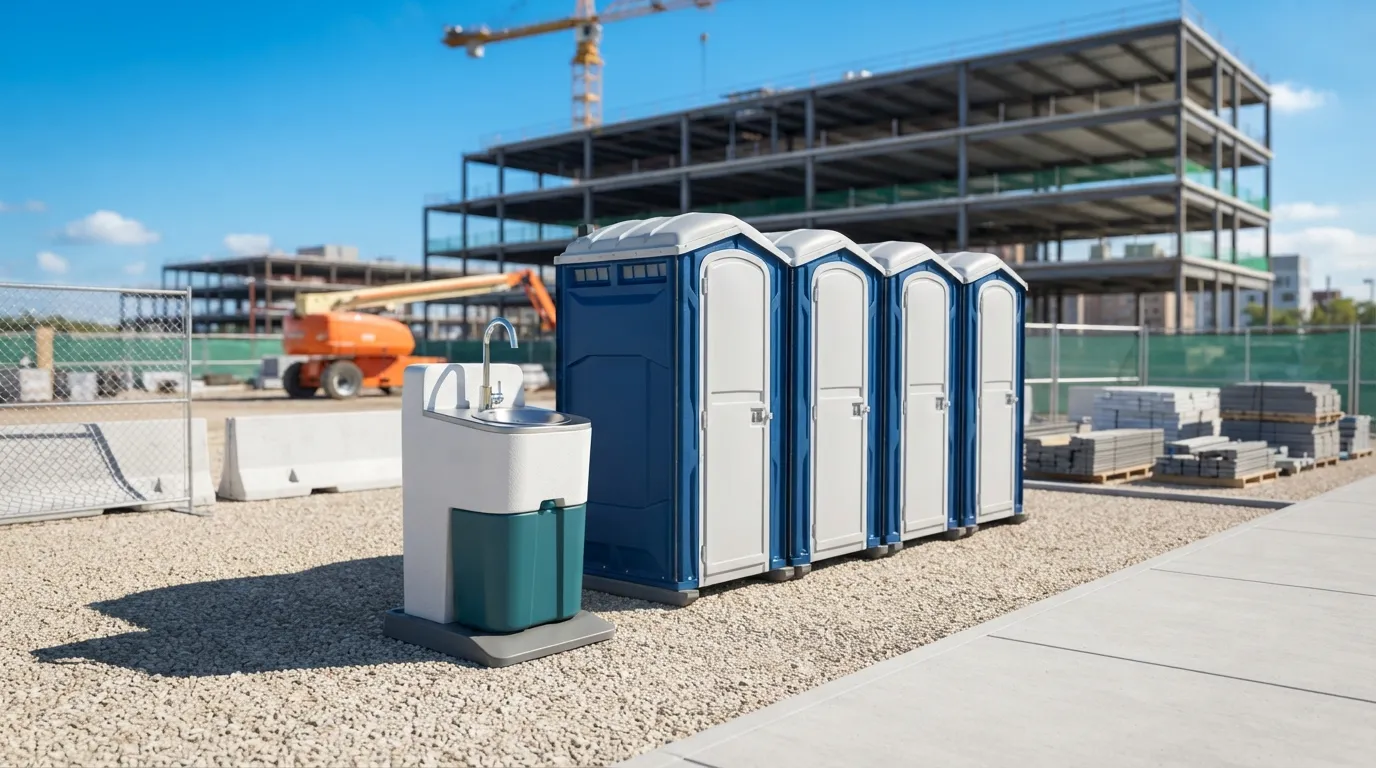
A standard unit runs a day rate for single-day events, but most race organizers book under an event rate instead, since race weekends usually mean delivery Friday and pickup Monday, and the porta potty rental per day numbers help you compare against a full event quote. Expect a delivery fee on top of the unit cost, and ask about weekend pricing if your race spans Saturday and Sunday only, or check monthly porta potty rental if your event runs a training season leading up to race day.
| Unit | Day | Week | Event |
|---|---|---|---|
| Standard | $100-$350 | $130-$500 | $200-$800 |
| ADA accessible | $200-$400 | $240-$400 | - |
| Deluxe flushable | $85-$1,200 | $150-$290 | - |
For a race with a VIP tent or sponsor hospitality area, a deluxe flushable porta potty or a small restroom trailer reads better in photos than a row of standard units. Check the full porta potty rental cost breakdown or the event restroom rental page if you are also planning a post-race festival with vendors and a beer garden, since that adds handwashing needs under 29 CFR 1910.141(d)(2), which requires soap and towels or a hand-drying device at every station, not sanitizer alone, and a festival restroom rental plan scales the same math up for multi-day events. A handwashing station rental placed near food vendors covers that requirement cleanly.
How far in advance should I book race restrooms?
Book as soon as your course and headcount are set, ideally 60 to 90 days out for a marathon-sized field. Yuma race weekends can overlap with events in Rancho Mesa Verde, 19.1 miles northwest, and races near San Luis, 28.8 miles west, pull from the same truck fleet.
Do I need ADA units even for a small local race?
Yes, if you expect any wheelchair or adaptive athlete division. ADA Standards section 213.2 sets the 5 percent minimum, and a 60 inch turning circle per section 304.3.1 needs clear ground around the unit.
Can restrooms be moved mid-race if the course changes?
Not easily once runners are on course. We stage clusters based on your final map, so lock the route before delivery day rather than planning a mid-event move.
What about restrooms for the finish-line festival afterward?
Add a second cluster or a restroom trailer rental sized for festival crowds, since finish-line dwell time runs longer than runner turnover during the race itself.
Should we add handwashing stations near food trucks?
Yes. Any vendor area needs handwashing separate from portable toilets, and a portable sink rental or dedicated station keeps you aligned with 29 CFR 1910.141(d)(2) near food service.
Next step
Get a delivery date
Tell us the address, the dates and the headcount. We size the order and confirm the route.